

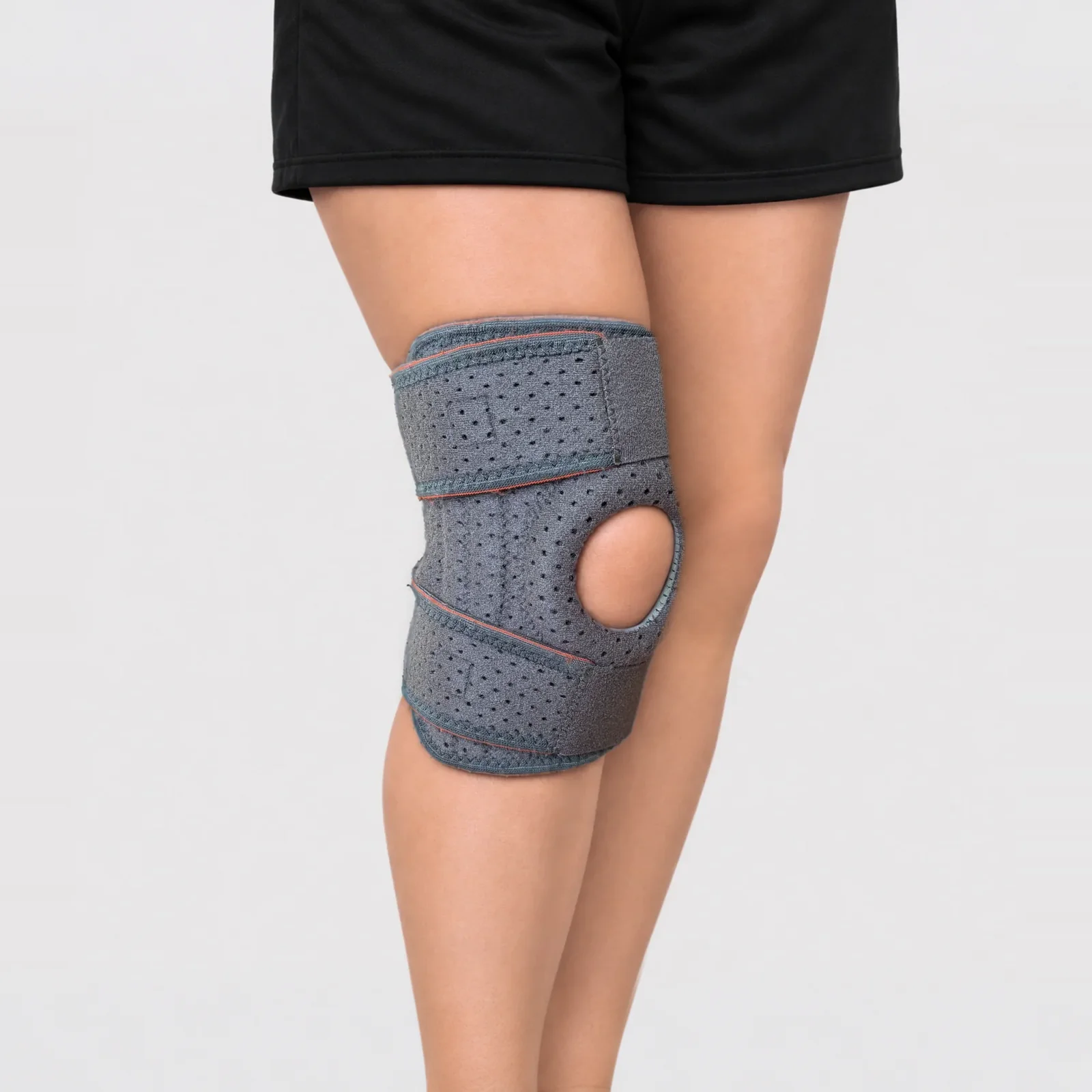
Should You Wear a Knee Brace When Running?
Wear one if your knee aches on runs and a brace makes those runs feel better, or if you're coming back after a break and want extra support. Skip it, and see someone, if the pain is sharp, the knee swells, or it locks or gives way.
Most runners who wear a knee brace aren't injured in the dramatic sense. They have a knee that grumbles after the long run, aches on the stairs the next morning, or feels a little less trustworthy on trails. For that kind of runner, a brace is a reasonable tool.
What a brace can do is add support, keep things feeling more stable, and make you more confident on the runs that usually bother you. What it can't do is fix why your knee hurts. That usually comes down to how much you're running, how fast you've built up, and how strong your hips and thighs are.
Runner's tip
Put it on before you run, not when it starts to hurt. A brace works while the knee is loaded. Pulling it on at mile four, once the ache has started, gives you much less to go on than wearing it from the first step.
Which Knee Brace for Running? Start With Where It Hurts
The spot that hurts tells you more than any product description will. Use this as a rough map:
| Where it hurts | What it often is | What usually fits |
|---|---|---|
| Around or behind the kneecap, worse on stairs, squats and downhills | Runner's knee (patellofemoral pain), the most common running injury (Taunton et al., 2002) | Open-patella brace: padding around the kneecap, adjustable straps |
| Just below the kneecap, a spot you can press on | Patellar tendon pain ("jumper's knee") | Patella strap: a band across the tendon |
| A general, all-over ache after longer runs | Overload, stiffness | Knee sleeve: light, even compression |
| Outside of the knee, often later in a run | IT band syndrome | A brace rarely helps much. Work on load and hip strength. |
| Deep inside the joint, with catching or locking | Possible meniscus problem | See a doctor before running on it. |
| The knee feels like it might give way | Possible ligament problem | See a doctor. Hinged braces are a medical call. |
This is a starting point, not a diagnosis. If the same pain keeps coming back for more than a couple of weeks, a physical therapist can tell you what's going on in one visit, and that's worth more than any brace.
Knee Sleeve vs. Knee Brace vs. Patella Strap
All three can work for running. The real differences are how much each one adjusts and how well it stays put once you start sweating.
Knee sleeves pull on like a tube and give gentle, even compression. They're comfortable and cheap, and many runners like the warm, held-together feeling. The catch is that a sleeve has one fit. A little loose and it rolls down; a little tight and it squeezes everything. On hot days, sweat makes the sliding worse.
Patella straps are a single band that sits below the kneecap. They're the least you can wear, which is exactly why runners with tendon pain like them. They don't do anything for the rest of the knee.
Wraparound open-patella braces open flat and close with straps, with a hole for the kneecap. Because you set each strap yourself, you can make it firm above and below the knee without squeezing the whole joint. They're bulkier than a sleeve but stay put much better, which matters more the longer you run.
For the full range beyond running, including hinged and post-surgery braces, see our guide on how to choose the right knee brace.
What Makes a Good Knee Brace for Running?
If you're thinking about your brace during a run, it's the wrong brace. Running is harder on a brace than walking. You're bending the knee thousands of times, sweating into the fabric, and moving fast enough that anything loose starts to migrate. That's why these five things matter more for runners than for anyone else:
- Grip that survives sweat. Look for silicone on the inside of the straps or cuffs. Smooth fabric slides once it's wet.
- Separate adjustment above and below the knee. Your thigh and calf aren't the same shape, and one strap can't fit both.
- An open kneecap with padding around it. This lets the kneecap move while spreading pressure around it, instead of pressing it flat.
- Somewhere for heat to go. Ventilation holes and a wicking lining make a big difference after 30 minutes.
- Nothing behind the knee. Fabric that folds in the back of the knee rubs on every single stride.
How the Mrjoint Knee Brace Measures Up
Our founder, Theo, ran track and field. After knee injuries, he went through the usual 2-strap and 3-strap braces and kept hitting the same problems: they shifted mid-run, needed constant readjusting, pressed behind the knee, and felt bulky. So he redesigned the brace around those problems.
- Stays put: double-layer wave-pattern silicone strips on both wide straps grip the leg instead of sliding on it.
- Adjusts in four places: four independent straps, a wide and a narrow one above the knee and the same below.
- Open kneecap: an EVA ring pad surrounds the opening and spreads pressure around the kneecap.
- Side support: four spiral spring stabilizers, two per side, that flex with the knee. They're tested to 4,000,000 flex cycles without breaking.
- Heat and sweat: honeycomb ventilation holes and a moisture-wicking inner lining.
- Nothing behind the knee: an open back, so there's nothing to bunch when you bend.
- Weight and fit: 7 oz (200 g); fits a thigh of 14″ to 20″ measured 3″ above the knee, on either leg.
Over 100,000 sold, and you have 60 days to return it if it doesn't suit your running.
Does a Knee Brace Help Runner's Knee?
It can help, but probably not in the way the packaging suggests.
Runner's knee is a dull ache around or behind the kneecap. It tends to build during a run, flares on downhills and stairs, and often shows up the morning after as stiffness when you stand up. In a study of 2,002 injured runners, it was the single most common diagnosis (Taunton et al., 2002).
An international panel of researchers looked at everything we know about treating it. Their strongest recommendation was exercise, especially hip and knee strengthening together. On braces and taping, the evidence is still unclear (Crossley et al., 2016).
That doesn't mean a brace is useless. Plenty of runners find an open-patella brace makes their runs feel better while they build strength. It just means you should be suspicious of any brand that promises a brace will fix runner's knee on its own.
Runner's tip
If you're shopping for runner's knee, look for an open kneecap with padding around it, separate straps above and below, and grip that holds through sweat. A plain sleeve or a below-the-knee strap isn't designed for this kind of pain.
How Tight Should a Knee Brace Be for Running?
Firm, not tight. It shouldn't move when you jog in place, and you should still be able to slide two fingers under the edge. Tingling, numbness, or a color change below the brace means it's too tight.
Most runners get this wrong in the same direction: they crank it down to stop it sliding. A brace that grips well doesn't need to be tight, and a tight brace gets uncomfortable fast once your leg warms up mid-run.
Do a quick test before you head out. Put it on, bend your knee fully a few times, and jog in place for 30 seconds. If it shifts, it's too loose; if it pinches or digs in when you bend, it's too tight. Adjust, then go.
How to Keep Your Knees Happy Beyond the Brace
The brace is the easy part. These habits do more of the work:
- Build up gradually, but don't worship the 10% rule. It's a fine rough guide, but a trial with 532 new runners found that a 10%-a-week plan led to the same injury rate as a faster plan (Buist et al., 2008). How your knee feels the day after a run is a better guide than any percentage.
- Do the strength work. Two or three short sessions a week of hip and thigh exercises (side planks, glute bridges, step-downs, squats) have the best evidence behind them for kneecap pain (Crossley et al., 2016).
- Respect the downhills. Running downhill loads the joint behind your kneecap harder than running on the flat (UNLV study). Shorten your stride and take quicker steps on the way down.
- Swap some runs for cycling or swimming when your knee needs a break, so you keep your fitness without the pounding.
- Back off early. A day or two of easier running when the ache first shows up beats three weeks off later.
The knee is the most frequently injured area in runners. Across 17 studies, the share of runners who got injured ranged from about 19% to 79% (van Gent et al., 2007). Most of those injuries come from doing a bit too much, a bit too soon, which is the part you control.