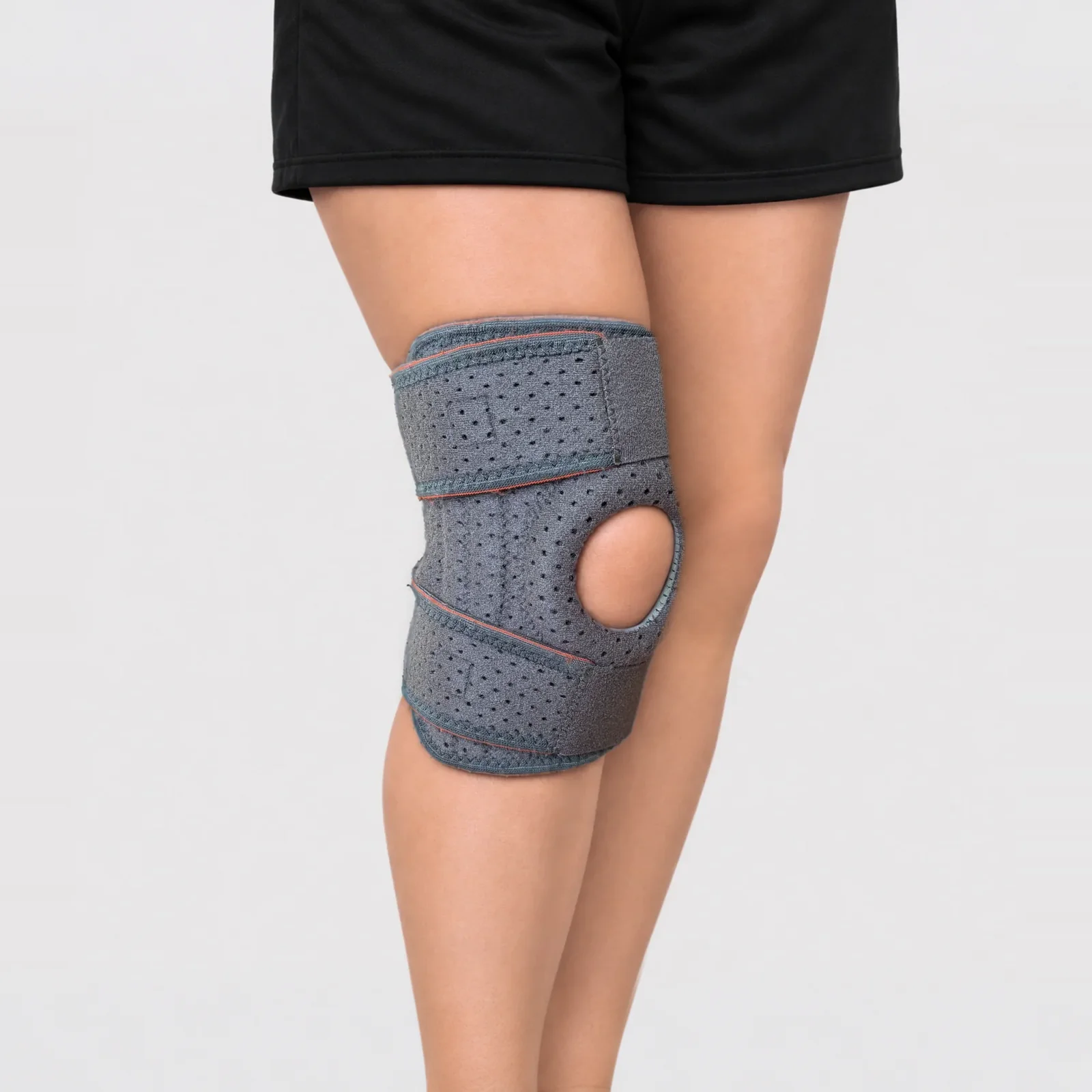
Choosing the right knee brace starts with one question: what does your knee need help with? A sore knee after a long shift, a knee that feels wobbly on stairs and a knee recovering from surgery all call for very different kinds of support.
Knee discomfort is common. A review in American Family Physician found that knee pain affects approximately 25% of adults, and the number of brace styles on the market has grown to match. The hard part is no longer finding a brace. It is finding one that suits your knee and that you will actually keep wearing.
This guide walks through what knee braces are for, how they work, the main types, and which kind of brace people usually choose for each common knee problem, so you can pick with confidence.
Key Takeaways
- A knee brace is support, not a cure. Braces add stability, compression and a sense of security, which can make everyday movement and recovery more comfortable.
- The right type depends on the problem. Compression sleeves and wraparound braces cover everyday aches and mild instability. Hinged, unloader and custom braces are for injuries and conditions that need more control, usually with a clinician's input.
- Design and fit decide whether a brace helps. A brace that slides down, pinches or overheats ends up in a drawer. Anchor points, grip and adjustability matter as much as the brace type.
- Bracing works best as part of a plan. A brace should sit alongside strengthening and, where needed, physical therapy. On its own it can give a false sense of security.
What Are Knee Braces For?
At its simplest, a knee brace supports the joint. That support can mean very different things depending on why you are wearing it.
After an injury. Sprained ligaments, strained tendons and meniscus tears are some of the most common reasons people reach for a brace. Support around the joint helps protect healing tissue from movements that could set recovery back. More serious ligament injuries, such as an ACL tear, usually call for a structured brace chosen with a clinician.
For ongoing knee problems. People living with arthritis or soreness around the kneecap often wear a brace to make walking, stairs and standing feel more comfortable. Some designs add warmth and compression. Others take some load off the most sensitive part of the joint.
After surgery. Following an operation such as an ACL reconstruction, surgeons often prescribe a specific brace that controls how far the knee can bend while it heals.
For extra stability. Plenty of people wear a brace without a specific injury. If your knee feels loose, has slipped out of place before, or simply feels like it needs backup during a workout or a long day on your feet, a brace can add that reassurance. Many athletes wear one as a precaution, although the evidence for braces preventing first-time injuries is still mixed.
How Do Knee Braces Work?
A brace can look like a simple piece of fabric and straps, but it supports the knee in several ways at once. Most braces rely on one or more of these four mechanisms.
Limiting unwanted movement. Rigid and hinged braces have firm supports along the sides of the knee. They help stop the joint bending backward too far or twisting sideways, which matters most after a ligament injury.
Compression. Soft, elastic braces press evenly around the joint. Many people find that this gentle, consistent pressure and the warmth it adds make a sore or puffy knee feel more comfortable, especially during activity.
Body awareness. Pressure on the skin gives your brain more information about where your knee is and how it is moving. This sense is called proprioception. Better feedback helps many people move more confidently and avoid awkward positions.
Redistributing load. Unloader braces use a rigid frame to shift some of the force away from one side of the knee joint. This is mostly used when arthritis affects one side of the knee more than the other.
Depending on its design, a single brace may do one of these things or combine several. A compression sleeve relies on squeeze and body awareness. A wraparound stabilizing brace adds structure on top. A hinged brace leans mostly on mechanical control.
Why Use a Knee Brace in the First Place?
Not every sore knee needs a brace. But for many people, the right one makes a real difference to how they get through the day. These are the most common reasons people start wearing one.
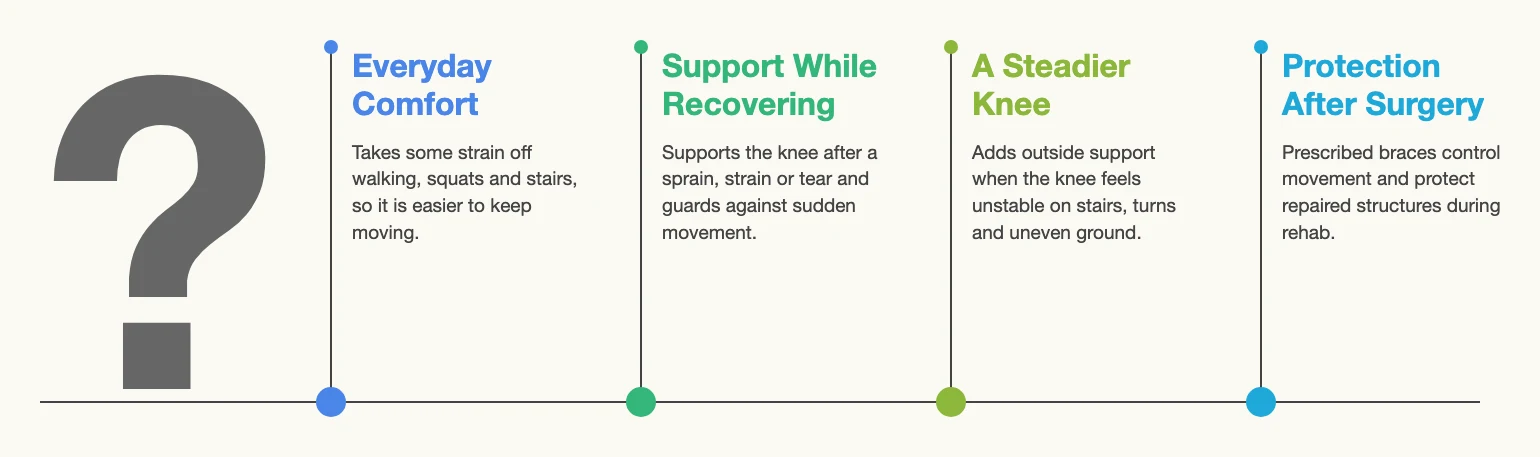
- Everyday comfort. For people with arthritis or a knee that aches by the end of the day, a brace can take some of the strain out of walking, squatting and climbing stairs. That support can make it easier to keep moving instead of avoiding activity.
- Support while recovering. After a sprain, strain or tear, a brace supports the knee while it heals and helps protect it from sudden movements.
- A steadier knee. When a knee feels unstable or has a history of giving way, a brace adds outside support and helps you feel more secure on uneven ground, stairs and turns.
- Protection after surgery. Post-operative braces are prescribed to protect repaired structures and control movement during rehabilitation.
Types of Knee Braces
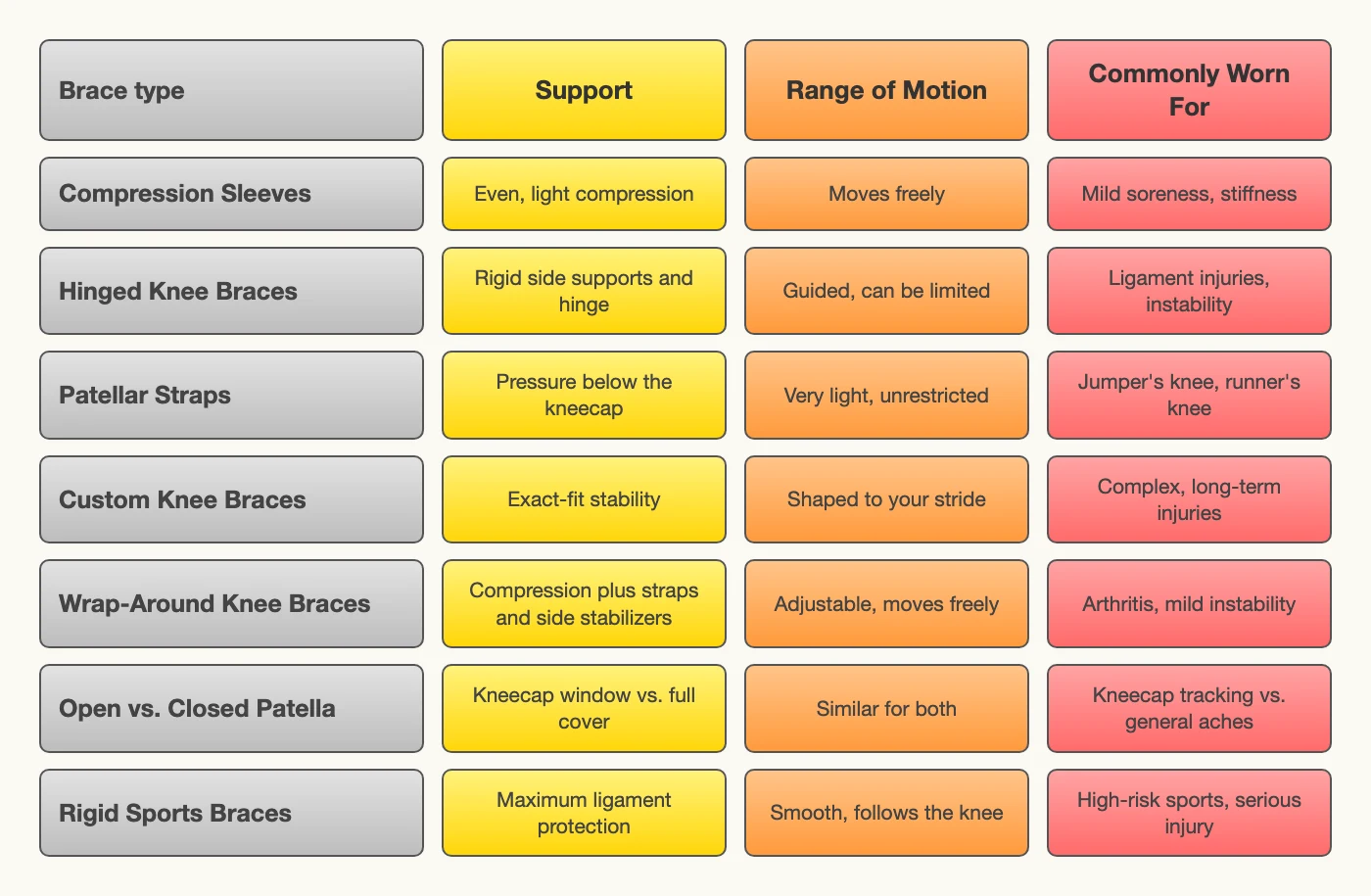
Knee braces are built for different jobs. Some are light enough to forget you are wearing them. Others are rigid frames designed to control every degree of movement. Knowing the main styles helps you match the brace to your knee.
Slip-On Braces (Compression Sleeves)
A compression sleeve is a tube of stretchy knitted fabric that you pull up over your foot and onto the knee. It is the lightest and simplest kind of knee support.
- How it supports: A sleeve applies even, all-round compression and adds a little warmth. Many people find this helps a stiff or achy knee feel looser and more comfortable to move.
- Range of motion: Sleeves move with you completely, so they are easy to wear during exercise, on walks or under clothes during a long shift.
- Who it suits: People with mild soreness, stiffness or early wear-and-tear, and active people who want light support. The trade-off is that a sleeve holds through squeeze alone. It offers limited stability, and many sleeves roll or slide down over a long day.
Hinged Knee Braces
A hinged brace has rigid supports down both sides of the knee, joined by a mechanical hinge at the joint.
- How it supports: The hinge lets the knee bend forward and back while helping limit side-to-side movement and over-straightening. This makes hinged braces a common choice after ligament injuries.
- Range of motion: Some hinges can be set to allow only a certain range, while others move freely. They are bulkier than soft braces, but better models follow the knee's natural movement closely.
- Who it suits: People recovering from ACL, MCL or other ligament injuries, people with significant instability, and athletes returning to sport after a serious injury, usually on a clinician's advice.
Patellar Straps and Bands
A patellar strap is a narrow band that sits just below the kneecap.
- How it supports: The strap presses lightly on the patellar tendon, the cord that connects the kneecap to the shin bone, to ease tension on it during movement.
- Range of motion: Straps are very light and leave almost the whole knee free.
- Who it suits: Runners, jumpers and young athletes with soreness just below the kneecap, including jumper's knee and runner's knee. A strap does not support the knee as a whole, so it is not designed for a knee that feels unsteady. Some people wear one alongside a sleeve.
Custom Knee Braces
A custom brace is built from a scan or mold of your leg, so it matches your exact shape.
- How it supports: Because it fits precisely, a custom brace can deliver targeted stability without slipping or creating pressure points, even on knees with unusual alignment.
- Range of motion: Custom braces are rigid, but they are shaped to move with your natural stride, so many people find them more comfortable over the long term than generic rigid braces.
- Who it suits: People with complex injuries involving several ligaments, unusual leg shapes, or long recoveries after major surgery. They are usually prescribed and fitted by an orthopedic specialist.
Wrap-Around Knee Braces
A wrap-around brace opens flat and fastens around the knee with straps, so you never have to pull it over your foot.
- How it supports: It combines compression with structure. Many wraparound braces add side stabilizers and an opening over the kneecap, giving more support than a sleeve without the bulk of a hinged brace.
- Range of motion: Straps let you adjust the fit around the joint, and the brace adapts to changes in swelling through the day. It stays light enough to move freely.
- Who it suits: People with arthritis, mild instability or swelling, and anyone who finds pulling on a sleeve difficult. It is a good middle ground for stairs, squats and long days on your feet.
The Mrjoint Knee Brace is a wraparound stabilizing brace built around the details that decide whether a brace stays where you put it:
- Four-Strap Cross-Torsion System: four independently adjustable straps wrap the knee from four anchor points, so it holds steady without being cranked tight.
- Four spiral spring stabilizers, two on each side, flex as you bend and spring back as you straighten.
- Double-layer silicone grip strips on both wide straps help keep it from sliding down.
- An EVA ring pad around the open kneecap and an open back that stops fabric bunching behind the knee.
It fits either knee and knee circumferences from 11.8 to 18.9 in.
Open vs. Closed Patella Braces
Braces differ in how they handle the kneecap. An open patella brace leaves a window over the kneecap. A closed brace covers the whole joint.
- How they support: An open design takes direct pressure off the kneecap and, with a padded ring, helps keep it on track. A closed design gives even compression across the whole knee and a little more warmth.
- Range of motion: Both move similarly. Open designs often feel cooler and lighter, while closed ones feel more uniform.
- Who they suit: Open patella braces are often chosen for kneecap tracking problems and pain around the front of the knee. Closed braces suit general aches, arthritis and swelling.
Rigid Sports Braces
At the far end of the scale are rigid functional braces with lightweight frames, often made from carbon fiber or aluminum.
- How they support: A strong frame and precision hinge give maximum protection to the knee ligaments and guard against twisting and over-straightening.
- Range of motion: Despite the frame, modern hinges line up with the knee's natural pivot point, so movement stays smooth.
- Who they suit: Athletes in high-risk sports such as skiing, snowboarding, motocross and contact sports, especially after a serious ligament injury. For everyday activity and less extreme sport, a wraparound stabilizing brace usually gives enough support with far more comfort and freedom of movement.
Key Factors in Choosing Your Knee Brace
Once you know which type you need, the details decide whether a particular brace works for you. Here is what to check:
| Factor | What to Look For |
|---|---|
| Support level | Match the brace to the problem. Light support for everyday aches, more structure for instability, and rigid support for serious injury or recovery after surgery. |
| Fit and sizing | A brace that is the wrong size slides down or digs in. Look for a clear size range, such as a knee-circumference measurement, and straps you can adjust one at a time. |
| Staying in place | Grip strips on the inside and several anchor points keep a brace from migrating down your leg as you walk. |
| Comfort | If you will wear it for hours, look for a padded kneecap opening and an open back that does not bunch when you bend. |
| Materials and airflow | Ventilation holes and a moisture-wicking liner help in warm weather or during exercise. Neoprene-based fabrics hold more warmth. |
| Ease of use | Wraparound braces with hook-and-loop straps are easier to put on and adjust than pull-on sleeves, especially with a stiff or swollen knee. |
| Build quality | Strong stitching, durable straps and closures that keep their grip matter if you plan to wear the brace often. |
| Value | The cheapest brace is poor value if it ends up unused. Pay for the features that keep it comfortable and in place. |
Best Knee Braces for Specific Conditions
Different knee problems need different levels of support. Below, we look at what to look for in a brace for each common problem, and where a wraparound stabilizing brace like the Mrjoint Knee Brace fits in. For any new, severe or worsening knee problem, get it checked by a healthcare professional first.
Best Brace for Osteoarthritis
Osteoarthritis is the most common form of arthritis. According to the CDC, it affects more than 32.5 million adults in the US. It develops as the cartilage that cushions the knee joint wears down, which can leave the knee stiff, achy and harder to move.
Braces for osteoarthritis tend to work in one of two ways. Unloader braces shift load away from the most worn side of the joint and are often suggested for more advanced arthritis that affects one side of the knee. For milder arthritis, many people prefer a softer brace that adds warmth, compression and some structure without the bulk.
Look for:
- A level of support that matches how advanced your arthritis is
- For more advanced, one-sided arthritis, an unloader brace fitted with a clinician's guidance
- For mild to moderate arthritis, a brace that combines compression with structure, such as side stabilizers
- Easy on and off, since stiff knees and hands can make pull-on sleeves frustrating
Where the Mrjoint Knee Brace fits: Many people managing mild to moderate arthritis wear it to stay active. The wraparound design goes on without pulling anything over your foot, the four adjustable straps let you set the fit around a stiff knee, and the spring stabilizers flex with you on stairs and when you stand up from a chair.
Best Brace for Chronic Knee Pain
Chronic knee pain covers any knee discomfort that lingers for three months or more. It often has no single dramatic cause. It is the knee that aches after a long walk, protests on the stairs, or stiffens up after sitting.
For this kind of everyday ache, the best brace strikes a balance. It needs enough compression and structure to feel supportive, but it has to be comfortable and breathable enough to wear for hours without feeling bulky.
Look for:
- A balance of compression and light, flexible structure
- Ventilation and a moisture-wicking lining for all-day wear
- Grip strips that stop the brace sliding down while you walk
- An open kneecap and open back to avoid pressure points
Where the Mrjoint Knee Brace fits: It is built for exactly this kind of all-day wear. Double-layer silicone grip strips and four anchor points keep it in place, honeycomb ventilation holes and a moisture-wicking liner help keep it comfortable, and the open back means nothing bunches behind the knee when you sit down.
Best Brace for ACL Injuries
The anterior cruciate ligament (ACL) is one of the main ligaments holding the knee together, and ACL tears are among the most serious knee injuries. Many need surgery and a long rehabilitation.
A brace for an ACL injury needs to control rotation and stop the shin bone sliding forward under the thigh bone. Functional braces are often used when returning to sport after ACL surgery, mainly to help athletes feel more confident in the knee.
Look for:
- A rigid frame, often carbon fiber or aluminum, for maximum stability
- A hinge designed to control over-straightening and forward movement of the shin
- A close, low-profile fit, either custom or a high-quality off-the-shelf design, that does not rotate or slip
- A brace chosen with your surgeon or physical therapist
For a fresh or serious ACL injury, a soft brace is not enough. Once you are cleared to return to everyday activity, many people move to a lighter wraparound brace for daily support. Our guide to knee braces for ACL injuries covers the options in detail.
Best Brace for Meniscus Injuries
The meniscus is the C-shaped cartilage that cushions the knee joint. Tears often happen during twisting or deep squatting, and they can make the knee feel stiff, swollen or as if it catches.
Braces for meniscus problems aim to limit twisting and side-to-side movement. Hinged braces are common after surgery, while milder tears are often managed with a soft brace that adds stability.
Look for:
- Side-to-side stability to help protect the joint
- A design that limits twisting movements
- For a tear alongside arthritis, a brace that can take some load off the affected side
- After meniscus surgery, the controlled-motion brace your surgeon recommends
For milder meniscus irritation once you are back on your feet, a wraparound brace with side stabilizers, like the Mrjoint Knee Brace, adds structure on both sides of the knee while still letting it bend naturally.
Best Brace for Patella Injuries
Kneecap problems include soreness in the patellar tendon, a kneecap that does not track smoothly, and a kneecap that feels like it shifts. The right brace depends on which one you have.
Look for:
- For soreness in the patellar tendon, a strap that presses just below the kneecap
- For tracking problems, a brace with a pad or ring that helps guide the kneecap
- An open-patella design that keeps pressure off the kneecap itself
- Advice from a clinician on which problem you have, since the brace differs for each
The Mrjoint Knee Brace has an open kneecap surrounded by a thickened EVA ring pad, which spreads pressure around the kneecap rather than on top of it.
Best Brace for Trauma and Post-Surgery
After a serious injury or knee surgery, the knee needs maximum protection and tightly controlled movement while it heals.
Post-operative braces use adjustable hinges that let the surgeon set exactly how far the knee can bend, then open up the range gradually as recovery progresses.
Look for:
- Full immobilization or strictly controlled movement
- A hinge you can lock at specific angles
- Long, rigid supports running from the thigh to the calf
- A brace labeled as post-operative or rehabilitative, usually prescribed by your surgeon
You would wear this type of brace only on your surgeon's instructions. Many people move to a lighter, more comfortable brace once they are cleared for everyday activity.
Best Brace for Injury Prevention and Athletic Use
Some people wear a brace not because of an injury but to feel more secure during sport and training. A brace for active use needs to support the knee without getting in the way.
The research on braces preventing first-time injuries is mixed, so think of a brace as added support and body awareness rather than a guarantee. Strength, warm-ups and technique still do most of the work.
Look for:
- Support that does not restrict athletic movement
- Structure that helps guard against awkward twisting and sideways movement
- A full, natural range of motion
- A secure fit that will not slide down mid-session
Where the Mrjoint Knee Brace fits: It suits active people who want more than a sleeve without the bulk of a hinged brace. The spring stabilizers flex with every squat and stride and spring back as you straighten, while the grip strips and four-point strap system keep it in place through running, training and long days on your feet.
What to Consider When Choosing a Knee Brace
Not all knee braces are equal, and the best one for someone else may not suit you. Before you buy, work through these points:
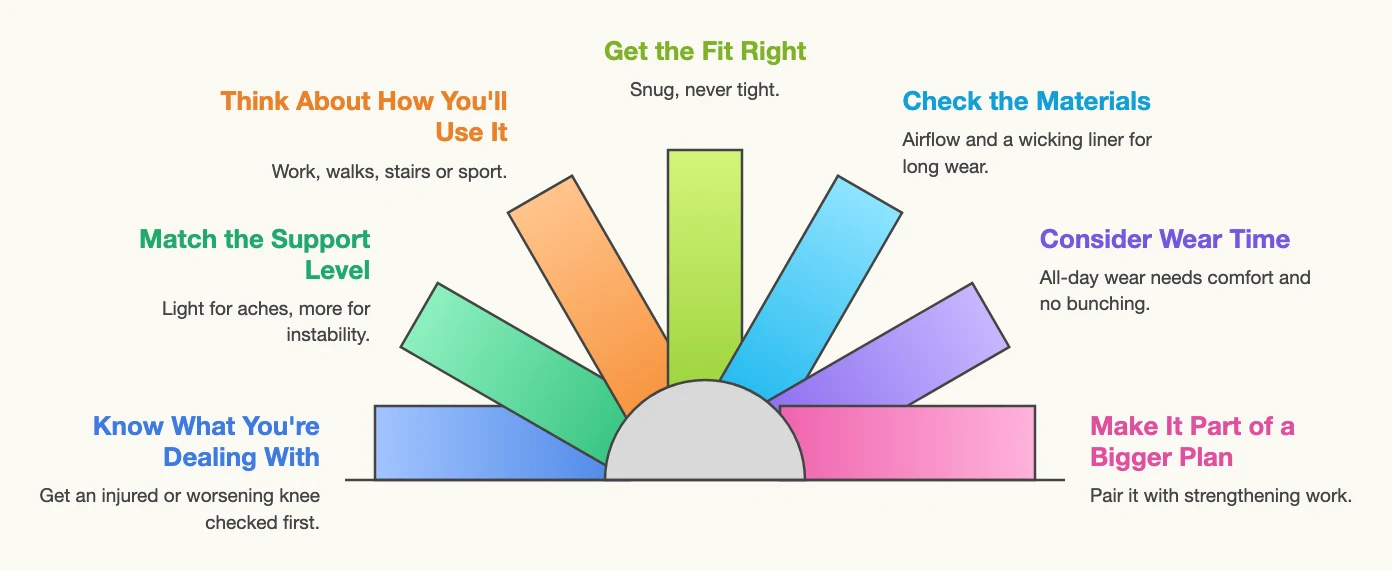
- Know what you are dealing with. If your knee was injured, gives way, locks or keeps getting worse, see a healthcare professional first. A diagnosis tells you what kind of support you actually need.
- Match the support level to your needs.
- Light support for everyday aches and mild swelling
- More support for instability or returning to activity
- Maximum support for recovery after surgery or serious instability
- Think about how you will use it. Work, walks, stairs and sport each put different demands on a brace. For active use, look for side stabilizers and adjustable straps that hold the knee securely without restricting movement.
- Get the fit right. Too tight and a brace can restrict circulation. Too loose and it will not support anything. Check the size range against your measurements and look for adjustable straps.
- Check the materials. Ventilation holes and a wicking liner help with airflow during long wear. Neoprene-based fabrics hold warmth, which some people find soothing for stiff joints.
- Consider how long you will wear it. If you plan to wear it all day, prioritize comfort, airflow and a design that will not dig in or bunch up.
- Make it part of a bigger plan. A brace works best alongside strengthening exercises and any therapy your clinician recommends.
Tip: Treat your brace as one tool, not the whole solution. Paired with regular strengthening, it can help you stay active while your knee gets stronger.
Benefits and Limitations of Knee Braces
Knee braces can make a real difference to how your knee feels day to day, but they have limits too. Knowing what they can and cannot do helps you set realistic expectations.
Benefits
Used correctly and as part of a wider plan, a knee brace can help:
- Make walking, stairs and standing feel more comfortable
- Add stability and support around the joint
- Improve body awareness, so you move with more control
- Give you the confidence to keep moving and stay active
- Help you feel more secure when returning to activity after an injury
Many people who wear a well-fitted brace say they simply feel more secure in their knee, which can make it easier to stay active.
Limitations
Braces also have limits:
- They are not a substitute for rehab. A brace does not strengthen the muscles around the knee or repair what is causing discomfort.
- They can create false confidence. Feeling supported can tempt people to push harder than their knee is ready for.
- Over-reliance can work against you. Wearing a brace constantly without strengthening work can leave the surrounding muscles underused.
- Bulk and comfort. Heavier, rigid braces can feel restrictive and reduce agility.
In short, a brace should support your recovery or training plan, not replace it.
Fit and Care
Even a well-designed brace only works if it fits. A poor fit can rub, slide, restrict movement or leave the knee less supported.
Getting the fit right:
- Measure around your knee as the brand's size guide describes and compare it with the stated range.
- The brace should feel snug and secure, not painful. You should be able to slide two fingers under each strap.
- Center any kneecap opening directly over the kneecap. For hinged braces, the hinge should line up with the middle of the knee joint.
- Watch for warning signs that the fit is wrong: tingling, numbness, cold toes, swelling below the brace, or red marks that do not fade.
Caring for your brace:
- Fasten the straps before washing so the hook side does not catch the fabric.
- Hand wash in cold water with a mild detergent.
- Air dry it flat, away from direct heat. Never put it in a dryer.
- Skip bleach and fabric softener, which can wear down the fabric, grip strips and closures.
- Check straps, closures and stitching regularly for wear.
If you wear a brace every day, a second one lets you rotate while the other dries.
Cost of Knee Braces
Knee brace prices vary widely depending on materials, features and how much customization is involved. As a rough guide in US dollars:
- Compression sleeves and patella straps: about $15 to $60, for light support
- Wraparound and soft stabilizing braces: about $30 to $100, for added support and mild instability
- Rigid functional and hinged braces: from about $250 to $1,000, often used after ligament injuries
- Custom braces: often $1,000 or more, built for complex or long-term needs
The Mrjoint Knee Brace is $54.95 for one. It is one size, fits either knee, and fits knee circumferences from 11.8 to 18.9 in. Packs bring the price per brace down: $39.98 each in a 2-pack and $34.95 each in a 4-pack. Every order comes with 60-day returns.
Tip: A 2-pack covers both knees, or gives you a spare to wear while the other one dries.
Does Insurance Cover Knee Braces?
Sometimes, but usually only for braces that are medically necessary. In the US, Medicare and many private plans may cover part or all of the cost when:
- A healthcare provider has prescribed the brace
- Your records show it is medically necessary, for example after ACL surgery or for an unloader brace for arthritis
- You get it through an approved durable medical equipment (DME) supplier
Even when a brace is covered, deductibles and co-pays often apply. Over-the-counter braces for everyday support are usually paid for out of pocket.
Choosing the Right Knee Brace for You
The right brace starts with understanding your knee. Once you know whether you are dealing with everyday soreness, instability or recovery from an injury, it becomes much easier to choose the right type.
Keep the trade-off in mind: the more a brace restricts movement, the more support it gives, but the less freely you can move. A sleeve may be all you need for a gentle walk, a wraparound stabilizing brace suits stairs, squats and long days on your feet, and a rigid hinged brace is the right call after a serious ligament injury. The goal is the best balance of stability and mobility for your knee and your day.
Important: Do not skip the strengthening work. No brace replaces the value of exercise, mobility work and, when needed, physical therapy. A brace works best as one part of a bigger plan for long-term knee health.
Final Words
A knee brace is one of the simplest ways to feel more supported through daily life, whether you are managing arthritis, recovering from an injury or dealing with a knee that aches by the end of the day. The right brace can make movement more comfortable and help you keep doing the things you enjoy.
Whichever brace you choose, consistency matters. Wear it for the activities where you need it, and pair it with strengthening work for the best long-term results.
If you want a brace that combines support, comfort and freedom of movement, the Mrjoint Knee Brace is built for exactly that: four anchor points, spring stabilizers that flex with you, grip strips that keep it in place, and an open design that stays comfortable all day.
Frequently Asked Questions
Which knee brace is best for arthritis?
It depends on how advanced the arthritis is. For mild to moderate arthritis, many people do well with a soft brace that combines compression with some structure, such as a wraparound stabilizing brace. When arthritis mainly affects one side of the knee and is more advanced, a clinician may suggest an unloader brace.
How does a knee brace help a knee that aches every day?
A brace adds even compression and a sense of support around the joint. Many people find that this makes walking, stairs and long days on their feet more comfortable. A brace with structure, such as side stabilizers and adjustable straps, also helps the knee feel steadier.
Is a custom knee brace worth the cost?
For most everyday knee discomfort, no. Custom braces are built for complex cases, such as several injured ligaments, unusual leg alignment or long-term recovery after major surgery. If your clinician has not recommended one, a well-designed off-the-shelf brace is usually the better value.
Can a knee brace stop me getting injured in sport?
No brace can guarantee that. Research on braces worn purely to prevent a first injury is mixed. A brace can help your knee feel steadier and more aware during activity, but strength training, warm-ups and good technique matter more.
How do I clean a knee brace?
Fasten the straps, then hand wash it in cold water with a mild detergent and let it air dry. Keep it out of the washing machine and dryer, and skip bleach and fabric softener. Check the straps and closures now and then for wear.